Issued
Pattern recognition is an essential skill for any meteorologist. As I recently posted online, which I will cover in more detail this month, being able to connect the dots between upper-level conditions and the surface is extremely useful and necessary for success as a meteorologist.
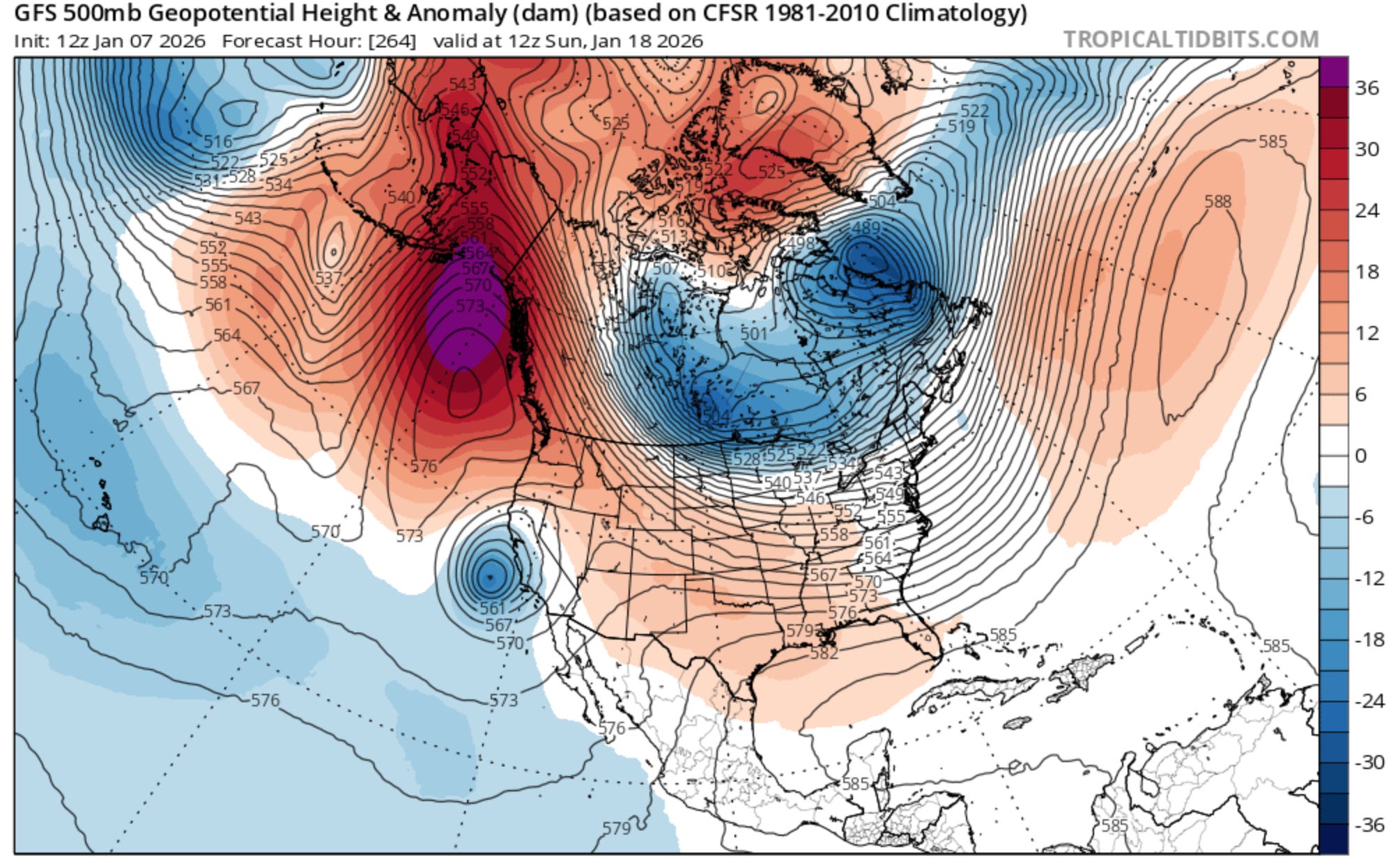
Using just this image, I can come up with the idea of icing as a risk. By watching the whole run and monitoring other models, I can with confidence convey a risk of icing in the Southern US in the next 2 to 3 weeks. Why, because I have had to predict this pattern so many times, I have a good sense for what features matter at different atmospheric levels. The client determines what and when you communicate this information.
-
Airlines, transportation departments, schools, and local sports teams might need to know for planning purposes, such as staffing. As the event gets closer, communication ramps up.
-
Energy clients will be much more interested, as utilities will want to understand how transmission lines and power may be affected and to plan for issues that may arise.
-
Energy traders will make trades based on short to mid-range conditions, especially if they know before the rest of the market knows, they can buy when prices are low.
This is not necessarily a skill you learn in college, but one you learn from working with other mets or meteorologists.
If this is an area where you need help, My Met Job will be offering an introductory 4-session instructor-led course starting in February. More details to follow.
The Jobs
United States
Emergency Management
Job Title: Intern
Company: Duquesne Light Company
Location: Pittsburgh, PA
Work-Location: Hybrid
Pay: Unknown
Hours: Weekdays.
Time Period: May to August
Qualifications:
Degree: BS or MS program in Emergency Management, Fire and Emergency Services, Disaster Management, or Business Continuity and Resilience. - You could try to use your meteorology if this is your focus.
Years: Completed your Sophomore or 2nd year of college.
Skills: Strong analytical mindset, with the ability to work in groups and communicate with various people.
Who Should Apply?
-
Anyone interested in working in emergency management, non-forecasting in energy, hydrology, extreme weather, and climate resiliency.
-
You enjoy analyzing datasets, enjoy learning new things, and meeting people.
-
This would be a great role for the non-forecasting meteorologists seeking a career in climate extremes and public safety.
General Operational Meteorology
Job Title: Meteorologist (2 openings)
Company: AlertMedia
Location: Austin, Texas
Work-Location: Remote
Pay: Base + Bonus
Hours: 24/7
Benefits: 100% paid for medical
Qualifications:
Degree: Bachelor’s in Meteorology, Atmospheric Science
Years: 2 to 3 years of experience in operational meteorology
Who Should Apply?
-
There are two openings, one is definitely nights, and the other has not been set yet.
-
You have experience forecasting and can handle covering multiple regions, including international, on your shift.
-
You really are fascinated by headline weather events, both forecasting and sharing about the event. You should be able to show this through your application, and your LinkedIn profile should showcase how much you are interested in this type of work.
-
Every time you read or see a major weather event, you wish you had been in charge of forecasting for that event or writing about it.
Maybe you have some experience, but not this exact experience. My Met Job will offer asynchronous and instructor-led training for operational meteorologists. Don’t miss your opportunity.
Energy - Utility
Job Title: Applied Meteorologist, Data Science
Company: E Source
Location: Boulder, CO
Work-Location: Remote
Pay: $90,000 - $145,000/year
Hours: Weekdays
Benefits: 100% paid for medical
Qualifications:
Degree: MS in atmospheric science, meteorology, engineering, mathematics, statistics, or similar field of study, plus one year of applied experience or PhD with applied analysis in the aforementioned field of study.
Years: Minimum of 3 years of experience conducting data science projects using spatial-temporal weather datasets in industry or applied research, including analytical design, managing schedules, and communicating results to stakeholders.
Additional Skills:
-
Experience fitting and assessing predictive models leveraging numerical weather forecasts in Python.
-
Experience conducting all phases of analysis, including data compilation, EDA, feature engineering, and generating deliverables
-
Experience with numerical prediction models such as GFS, ECMWF, and HRRR, along with the ability to use the AWS cloud computing infrastructure.
Who Should Apply?
Because this is a remote job, the company will likely receive hundreds of applications. For this role and future jobs, you need to stand out to show that your data science skills in meteorology are better than most people. This means you should be able to use weather models and Python to create a mock product that this company might deliver to utility customers. You should research the company to find out what they do, research the industry to learn where there is opportunity, and then create an application that solves a problem.
Tag or connect with people at the company to share the problem you solved and let them know you applied for this role. Otherwise, you are just one in a sea of candidates.
International (Every job outside the US)
Energy - Trading
Job Title: Senior Energy Trading Meteorologist
Company: JERA
Location: Singapore
Work-Location: Tokyo, Japan - Onsite
Pay: Unknown
Hours: Weekdays, early shift
Benefits: None given
Visa: No requirements given
Qualifications:
Degree: Master’s degree in meteorology or atmospheric science.
Years: Minimum 5 years
Additional Skills:
-
Your experience should involve producing high-stakes forecasts for customers, preferably in the energy industry, but experience in the military or with other industries is seen as advantageous.
-
Solid working knowledge of pattern recognition for APAC (Asia-Pacific), especially Northeast Asia and Japan. This would include the ability to monitor teleconnections and their impact on synoptic regimes and mesoscale conditions.
Beneficial Skills:
-
Python, AI/ML, webscraping.
Who Should Apply?
You want to live in Japan in a global city, but with access to world-class skiing in Nagano Honshu and Hokkaido, hiking and relaxing applying shinrin-yoku or forest bathing, and you want to be close to other regions such as India, Thailand, Bali, Australia, and New Zealand.
You have either significant experience in forecasting in the APAC region or globally, and want to work in energy, or you have an energy background already.
Final Thoughts
Over the course of my career, I have orchestrated job search strategies for a few dozen people and have directly assisted six people in receiving interviews, with 5 of those people accepting an offer.
Those may seem like small numbers, but these 5 meteorologists have gone on to much bigger roles, on a larger stage, and are having successful careers. I’ve also worked endlessly on connecting people to hiring managers or to other meteorologists in different industries. I regularly mentor and coach students, new graduates, and experienced meteorologists on how to get going or even just change jobs.
I’ve had the opportunity to work for 10 companies, meaning I reached the offer table at least 10 times, although I’ve unfortunately had to turn down 3 other offers I received. This is not to toot my own horn, but to suggest that I know what it takes to write hundreds of resumes and cover letters, many going unanswered or being rejected. I know how to speak to HR representatives on a first-round interview, and I understand how to prep for forecast tests of all shapes and sizes.
The biggest thing I’ve learned, though, is how to pick myself up after I fail in an interview. Especially one that I really wanted. I’ve learned how to regroup and go at it again.
A Solution for Your Future
If nothing else, My Met Job was created for the sole purpose of one meteorologist, me, helping other meteorologists build a successful career in meteorology, climate, or some other profession without making all the mistakes I did along the way, and making this happen a lot faster than the 15 years it took me.
My Met Job is a culmination of all the experiences I have gained from working as a forecaster, building a successful career, and helping other meteorologists along the way.
If you are,
-
Struggling to find a new role
-
Trying to land your first role
-
You have always wanted to be a meteorologist, but you were not good at math, physics, or chemistry, so you chose a different university degree. However, meteorology is still your passion even though you earn a living doing something else.
-
Maybe you are a meteorologist, and you want to work more in climate, but can’t find the resources to help guide you.
-
Or if you are in high school, or you are a parent and your children are at the point of choosing a meteorology career or a college, and you just need some advice.
My Met Job could be the answer you have been looking for to help you build the meteorology career you always dreamed about.
Stay tuned for more details. Feel free to express your interest or intrigue by commenting or sending me a message.
Good Luck!


Responses