Issued 10th of April 2026
Continuing with the discussion from last week about resumes, here are some tips about modular resume design.
Header
This should clearly state your name in the largest font you use on the resume, at least twice as large as any other section titles. This is the top of my resume. I use sans-serif font. Then, contact information below. You don't have to link to your LinkedIn; you could use your own website or anything else that would cast you in a good light.

There are variations on everything, and this is just the format I use. While you can design your resume however you want, the one thing to stay away from is getting fancy with the font style or color. Your resume is not about showing your flair. That is what LinkedIn, a website, or some other social media site should be used for.
Summary
I like to add a summary at the top that wraps up my experience into a short paragraph. I don't use the same summary for every job; instead, I change it up depending on the type of job. Whatever job opening I used this resume for, it was likely something very specific, as the content of the summary is climate and engineering-focused. This was probably a stretch job where I wasn't completely qualified, so I used big words to make it sound like maybe I knew more than I do.
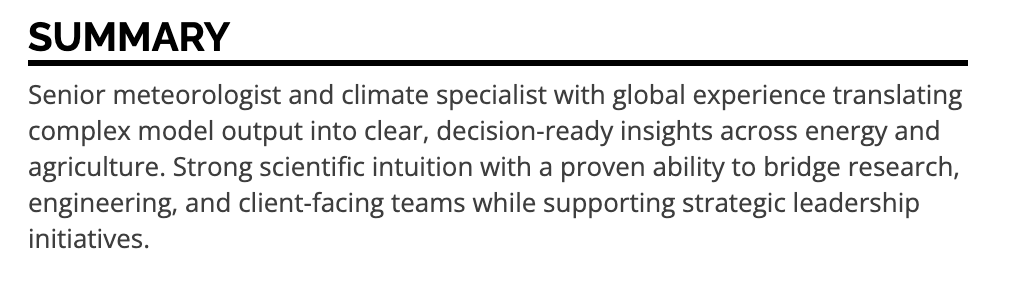
Often, I write a paragraph on my own and edit it until it reads just like I want, then I run it through AI and ask for a compressed 2-line example. I don't necessarily use this; I just want to compare what I said to what the AI thinks.
Experience
Look at my LinkedIn and compare it to my resume. My resume is very concise, compressed down to a few bullets per job experience. While my LinkedIn is a mess, with too much information.
(I've kept my LinkedIn like this on purpose for you, the reader, to see what really goes on at different types of jobs.)
First job. Make sure that if you are still working there, you are using the present tense.
I used 3 bullet points for this resume. Sometimes, if the lines are shorter, I will use up to 5.
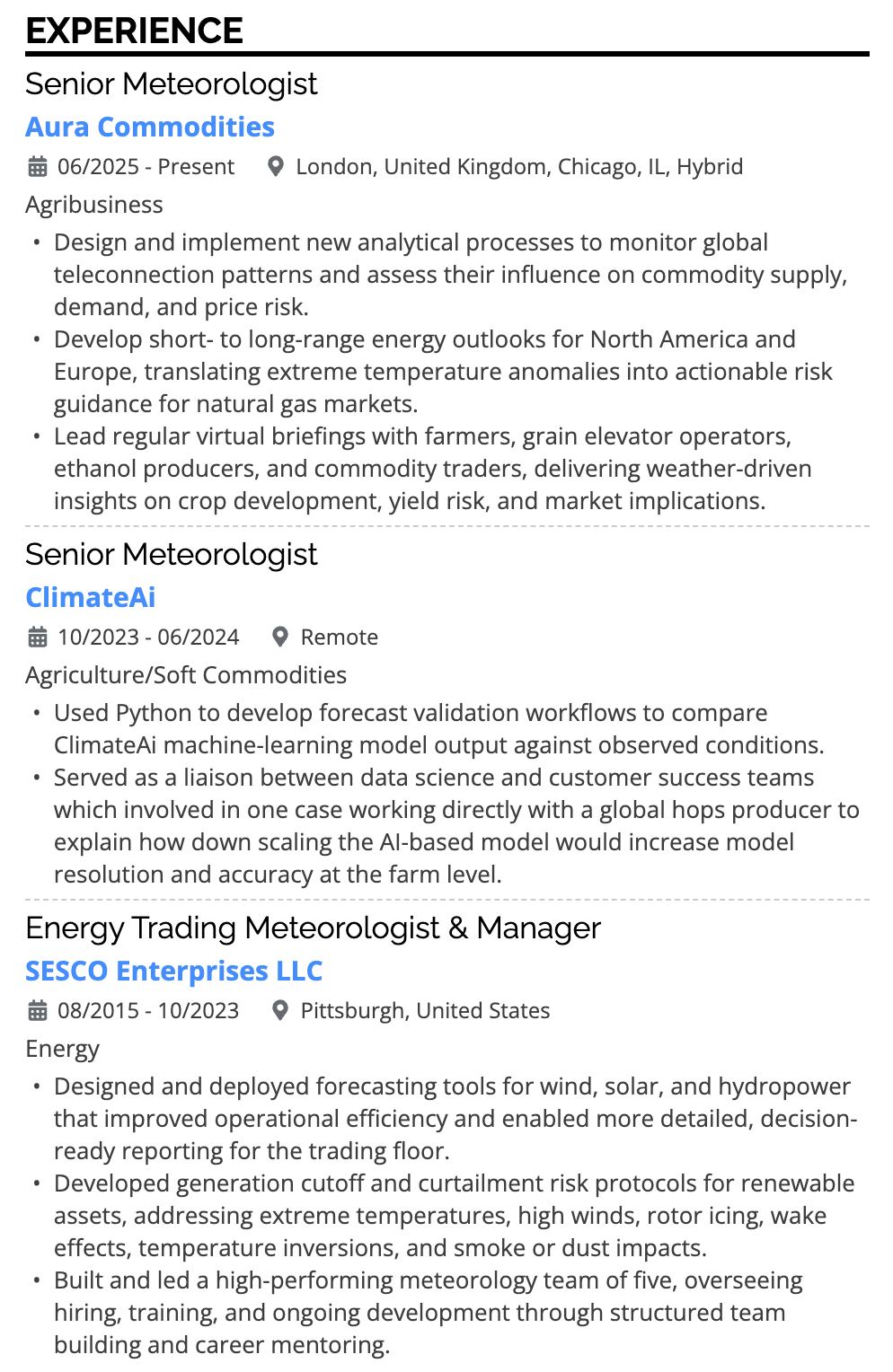
The most important detail about each job is what your title was, so put it first above the company. Hiring managers don't usually care where you worked.
Then I put the company name and make it stand out using a blue color. The only color other than gray or black on the resume. I would pick 1 to 3 colors and stick with that. Don't go full rainbow. You can do that somewhere else online.
Now I could flip the color highlighting effect to my work title. Either would work.
I don't think there are any spelling issues, and you want to edit this over and over to make sure the spelling is good and the grammar is correct. I'm terrible at grammar, so I use Grammarly (free version) to check issues. It's not perfect, but it helps.
On purpose, I have made this a 1-page resume. For me, this is because in these 3 jobs I have 10-years of experience, and the experience in each job is what I'm connecting to the opening.
These are just some ideas to consider when you are designing your resume.
The Jobs
USA Jobs
Industry: Television Media
Title: Meteorologist
Company: Synergis
Work Location: Atlanta, GA
Pay: $25 - $45/hour W2 contract
Benefits: See Post
Degree:
- Meteorology Degree, at least a Bachelor's
Years of Experience:
- 1+, posting doesn't say
Key Skills or Knowledge: (most important to the company)
- Experience writing in a newsroom, media, or digital publishing environment
- Strong ability to simplify technical weather data into digestible content
- Proven skills in news writing, storytelling, and content creation
- Comfortable working in a fast-paced, deadline-driven environment
- Familiarity with weather systems, forecasting tools, or climate topics
Additional Skills:
- Experience writing breaking news or live event coverage
- Understanding of SEO and digital content best practices
- Experience working alongside broadcast or digital weather teams
Who Should Apply?
Normally, I would not list a TV job, but this one is not really an on-air role, although it could expand in that direction. If you are not sure about on-air or where you want your career to go, this could be a good opportunity. You should have experience in creating copy for this type of work, so you understand the type of information that is for television media. Sounds like an interesting gig for the right person.
Industry: Climate Resiliency
Title: Environmental Project Coordinator
Company: Broward County, Florida (near Miami)
Work Location: Ft Lauderdale, Florida
Pay: $70,300 - $112,200
Benefits: See Job Posting
Degree:
- Bachelor's degree from an accredited college or university with major coursework in environmental planning, environmental science, or a closely related field.
Years of Experience:
- 2 years in environmental/natural resource programs or closely related experience, including 1 year of lead work/supervisory experience.
Key Skills or Knowledge: (most important to the company)
- Manages Complexity: Translate complex data from multiple sources into clear, concise language others can understand. Basically, what you would do as a meteorologist, but focused more on planning.
- Decision Quality: Working independently to make critical decisions that will affect the organization. You do this as a meteorologist.
- Optimizes Work Processes: Understand how to use the most efficient process to get things done and help show others how to be efficient as well. You do this when you learn model bias, learn where to get data, and use it to get answers faster.
- Ensures Accountability: Motivated to be better, and when you make a bad decision, you learn how to be better. - As a meteorologist, you are a professional at learning from failure.
- Drives Results: Consistently achieves results even when your work day is crazy busy and things come up, and ideas don't work out.
- Communicates Effectively: Develops and delivers multi-mode communications that convey a clear understanding of the unique needs of different audiences. Disseminates knowledge, insights, and updates in a polished, precise, and compelling manner. A requirement of every meteorologist.
- Persuades: Uses compelling arguments to gain the support and commitment of others. Meteorologists do this with customers every day.
- Manages Ambiguity: Pretty much the defining environment for meteorology.
Who Should Apply?
If you are a little more interested in climate, especially climate resiliency, or you can't find any jobs, then I would consider going this route. The job description is pretty much written where you could answer every requirement with something you do as a meteorologist.
About the Location
It doesn't snow. Fort Lauderdale. The Beach. Nothing else to say.
International Jobs (Outside the US)
Industry: Hydrology
Title: Chief Specialist
Company: Institute of Meteorology and Water Management
Work Location: Warsaw, Krakow, Wrocław, Poznań, Gdynia all in Poland
Pay: None Given
Benefits: See Posting
Degree:
- Master's in physics/atmospheric physics/meteorology/climatology
Years of Experience:
- 10 years.
Key Skills or Knowledge: (most important to the company)
- Knowledge of meteorology, climatology, numerical weather modeling,
- Knowledge of data analysis, processing, and visualization methods,
- Experience in using meteorological data formats GRIB I/II, NetCDF, HDF5,
- Programming skills (R or Python),
- Practical knowledge of the Linux environment,
Additional Skills:
- Knowledge of English sufficient to communicate, prepare scientific papers, and present results at conferences and seminars.
Who Should Apply?
You should speak and read Polish or plan to learn it, even though the job specifically states English; it may be beneficial if you can speak to your colleagues. The job reads more like it is a climate research sort of role, but the listing does mention long-range forecasting.
Closing Date:
13th of April 2026, so this Monday.
Industry: Marine and Road Weather, and some Energy
Title: Operational Meteorologist
Company: WSP
Work Location: Ottawa, ON, Montreal, QC, St. John's, NL, all in Canada
Pay: $54,200 - $75,600 CAD per year
Benefits: See Listing
Degree:
- Bachelor of Science in Meteorology or Atmospheric Science from a WMO-compliant program (required).
Years of Experience:
- 0-1, but not given.
Key Skills or Knowledge: (most important to the company)
- Bilingual fluency in French and English.
- Ability to work rotating day/night shifts, weekends, and holidays.
- Experience with GIS software, coding (Python, SQL, VBA), data analytics tools (Power BI, Tableau), or AI applications.
- Previous operational forecasting experience or willingness to work offshore on platforms and ships.
Additional Skills:
- Excellent communication and time-management skills; ability to perform under pressure during high-impact events.
- Strong critical thinking and problem-solving abilities in a collaborative team environment.
-
Self-motivated with a growth mindset and commitment to diversity and inclusion.
Who Should Apply?
Please note that basic French is required, as the job contract I had when I lived in St. John's, Newfoundland, requires speaking with clients in Quebec and New Brunswick (both bilingual provinces). I didn't speak any French, but we had a cheat sheet. If you are looking to get into meteorology, even if you don't speak French, apply and see where it goes. If they have already posted this once, then they may be willing to forget you don't know French. This could be your first job as a meteorologist.
About the Location
St. John's, Newfoundland
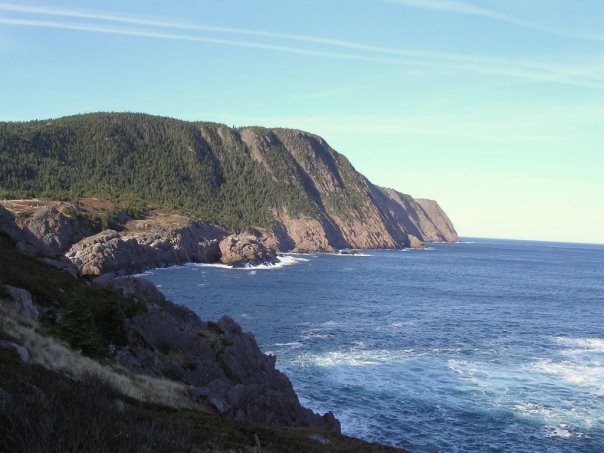
You should like cold weather. St. John's, Newfoundland. It feels like it is sunny for 1 month of the year and cloudy and wet the other 11 months. It is super windy, occasionally gets hit by a hurricane, has heavy ice storms, heavy snow, very dense fog, and little to no thunder or lightning. There are more moose than people, and they have a daily moose report on the radio because hitting a moose with your car is like running into a brick wall, so I've heard.
Montreal and Ottawa
I've never actually been to either, but I do know they are both extremely cold in the winter and that Montreal is supposed to be a lot of fun even with the cold. Both are pretty close to the US, and you could easily just drive across the border.
Final Thoughts
Writing a resume is not easy, but it doesn't have to be the make-or-break between you getting a job or not. If you struggle with resume writing or are not having any success getting through, I would suggest you work with someone, anyone. All you need is a template and a starting point that you can replicate with your own experience. Once you find something that works, you can mostly repeat it. If you find yourself in this spot, where you can't seem to get any traction, I've written dozens of resumes for myself, many variations that have landed interviews, and others that have not. I have even re-written resumes for other meteorologists. Reach out if you want some help or need some direction, scott@mymetjob.com


Responses