Issued on the 5th of June, 2026
For all the new graduates, congratulations on surviving and earning your degree!!!
Hopefully, many of you have leads on a job right out of university.
For those of you who do not have a job lined up yet, the Friday Job Report is here to provide extra insight into jobs posted online and advice on how to conduct your job search, craft a resume and cover letter, and prepare for a successful interview. If you need more help, please reach out.
Ever since COVID, most companies have shifted to video-only interviews. Occasionally, a company may have you fly in and meet in person, usually for higher-level roles, and some companies also may use a phone call in the first interview.
My current job requires me to get on video calls with clients every single day, and so I can tell you the number one thing I wish people would change is turning on their camera. While they are the customer and can do what they want, when you are on a video interview call, you absolutely must turn on your camera.
You may not enjoy being on camera, but employers prefer to see who they are speaking with before they consider hiring you. In some cases, you may not have a working video feature on your computer. Use your phone. There are likely some use cases where you will not have a working video or microphone, but those are going to be few, and in that case, you should try to work with the interviewer to set up an alternate plan. Do not wait until the interview is scheduled to start to let them know.
I can definitely tell you that choosing not to go on camera will hurt your chances, and in a World where the opportunities are limited, you want to give yourself every chance you can.
When you are in a video, the best thing you can do is dress up from your waist up. How many times do I get on a call with a collared shirt, wearing gym shorts, and barefoot? Pretty much all the time. When I interview, I wear a suit jacket and tie, but below the camera, shorts and non-fancy shoes.
Also, don't be a social media star and have inappropriate clothing on, and accidentally stand up to adjust the monitor or something, and show off what you don't want to. Make sure whatever the other person will see is what you want them to see.
Make sure the screen is level, not tilted to one side, and do a test run to make sure your head is completely visible and that you are not so close that you take up the whole screen, but not so far away that they see more of you than you want.
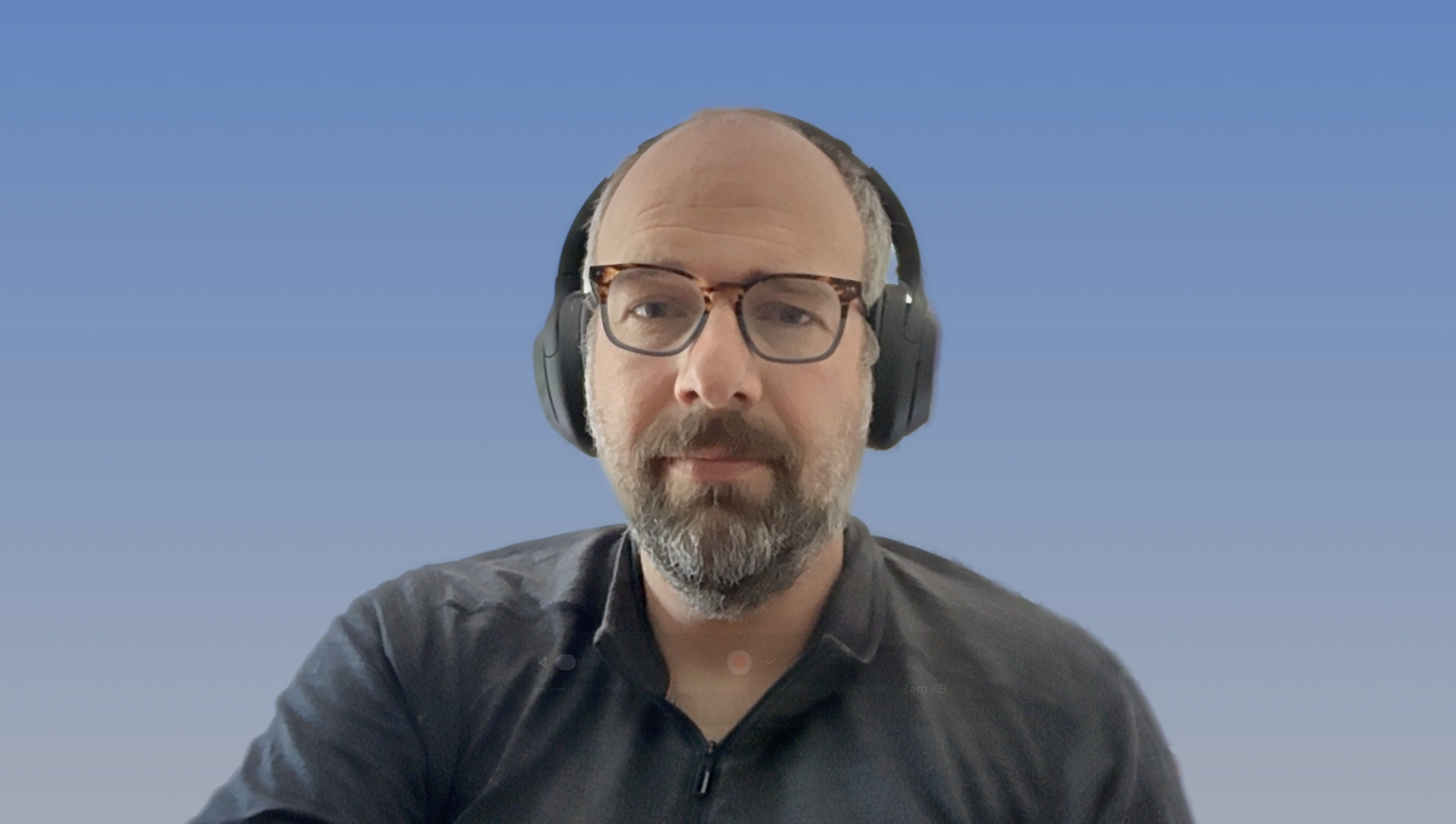
The image above is my super casual client meeting look. Right before the call, I throw on this sort of collared shirt, zipper a little higher, and I have my noise-cancelling headphones because I'm sitting next to an open window. There is a stack of pillows and photos on the wall behind me, but all you see is the blue screen.
This example image above is not appropriate for an interview, and barely ok in my company for a meeting with a client, but I wanted to show the amount of body and your head that should be in the camera view.
For interviews, you can blur the background. This is totally reasonable. The blur function can be found on MS Teams, Zoom, and Google Meet.
However, sometimes you want to create a theme to show off who you are, like on a TV interview, you may see a person sitting in front of a bookshelf, and if you were to read the titles, they probably have been curated perfectly for the interview.
My setup, when I want a theme background, is I sit in a hallway in front of a bookshelf. On the bookshelf are weather books, some other non-fiction titles, an atlas or something, and a model of a wind turbine, when I'm doing energy calls. On this same topic, people make judgments about you and your character, even without knowing they do this, the first time they see you.
Don't do your interview in a messy room.
Don't wear sports team clothing, have a poster or anything that can define you as a fan, in case the interviewer is an opposing fan. (Once you get the job, you can then let everyone know which team you support.)
Don't have weapons in the shot, unless you are prepared to discuss the significance to you. If you like to hunt, that's fine, but I would suggest waiting until you get the job and then reading the room and letting people know you like to hunt.
Don't bring your kids or other family members on the call.
Don't have your mom try to make a case for you. (This has happened with a candidate I was interviewing, and they did not get the job, and this did factor in.)
Before you get on the call, make sure the video quality is good and the microphone works. If you are wearing headphones, make sure they are connected to the Bluetooth. I usually listen to music on my computer, right up to the video call, to ensure the connection is there.
If you are in a location with a lot of people, you need to be able to mute the surrounding noise or explain the situation to the interviewers, in case they hear other voices. Make sure you don't have an open mic.
These are just some tips I've picked up along the way through interviews and from meeting with clients. Feel free to share yours in the comments.
The Jobs
USA Jobs
Industry: Risk
Title: Senior Weather Analyst / Machine Learning Researcher
Company: Jane Street
Work Location: NYC and London, England
Pay: $300,000 per year base
Benefits: See Company Website
Cover Letter: Not needed
Degree:
- Master's degree (minimum) in Atmospheric Science or related field
Years of Experience:
- See Job Listing
Key Skills or Knowledge: (most important to the company)
- Must be a strong programmer with excellent Python skills for data analysis
- Expertise in relevant topics such as: sub-seasonal predictability, data assimilation and numerical weather prediction, tropical variability, synoptic meteorology, and renewable energy forecasting
- Experience using gridded data, observational data, and satellite data to drive quantitative research in academia or industry
- Experience with AI models preferred
- Have good taste in research. The problems you will work on will aim to challenge the limits of atmospheric predictability. You should be comfortable pushing in new and unknown directions while maintaining clarity of purpose
- Think and communicate precisely and openly. We believe great solutions come from the interaction between diverse groups of people across the firm.
Who Should Apply?
If you like to solve problems, you should apply. This company is well known to be a rewarding place to work, and where else with just a Master's degree can you land a base salary in the three hundreds? This doesn't even include bonuses. While you shouldn't necessarily take a job for the money, you wouldn't have to work as long in your career if you were clearing half a million a year.
This company doesn't use a normal hiring process, which is good; it means they really care about who they hire. Please visit their website for detailed information about how they hire.
If you want to start with the best and you want to work in trading or risk, then this is where you should start. There are also many additional positions not in weather, but data-focused.
International Jobs (Outside the US)
Industry: Energy
Title: Met Forecast Analyst
Company: Unknown
Work Location: London, England
Pay: 
Benefits: See Job Listing
Degree:
- Degree in Meteorology or Atmospheric Science
Years of Experience:
- Experience in forecasting and data analysis.
Key Skills or Knowledge: (most important to the company)
- Clear and prompt communication of forecasts, both verbally and in writing, to internal stakeholders such as traders and analysts.
- Performing verification analyses to identify opportunities for improving forecast accuracy
- Analysing atmospheric and climate data, and contributing to research and development initiatives on the Meteorology desk using strong programming skills
Who Should Apply?
If you want to work in energy trading, you should apply, especially if you are already UK- or EU-based and have data analysis or data science skills. I think this role is a meteorologist that does make forecasts, analyzes model data, and creates graphics to present the data to the traders. Some of the meteorologists may actually be traders too.
It's worth noting that, at least on LinkedIn, already over 100 people have applied, which means getting an interview is going to be hard if you are not very qualified.
Also, the job poster is a recruiter. This means they usually either pass your resume to the actual company if you are a match, and then you might get an interview, or they do a weed-out interview to decide if they should pass you along because they get paid for having a successfully hired candidate.
Industry: Energy
Title: Market Analyst Forecasting Specialist
Company: Ontario Power Generation
Work Location: Toronto area, Canada
Pay: $86,000 to $134,000 CAD per year
Benefits: See Job Posting
Degree:
- Bachelor’s Degree (Meteorology, Atmospheric Physics, Econometrics, Economics, Math, Physics, Engineering, or an equivalent field)
Years of Experience:
- 6+ Years
Key Skills or Knowledge: (most important to the company)
- Requires experience or knowledge of the electric utility business, to be familiar with the inherent factors and problems influencing energy use, production, and transmission.
- Requires experience or knowledge to be familiar with the evolving electricity marketplace in Ontario and neighboring power systems, as well as the interrelationship of groups in the Business Unit and OPG as a whole.
- Requires experience in consulting with management, preparing various forecasts, and undertaking studies related to economic or energy market issues.
- Requires experience in the collection of data and the development and maintenance of databases for use as the primary information source for market analysis, forecasting, risk analysis, and alternative scenarios.
- Requires experience with or knowledge of econometric/statistical models. Experience in the interpretation of weather prediction models, analysis of short-term electricity demand drivers and weather-based demand response in power markets, econometric modeling, etc.
- Experience with MetrixND/ MetrixIDR is considered an asset
Who Should Apply?
Great job location, near Toronto, Canada, close to the US, doesn't appear to have a visa restriction. Not sure how much trading is involved, beyond just making forecasts and outlooks for their assets.
Final Thoughts
One thing that I believe is very important to share as meteorologists is what you actually do in the day-to-day. The reason this is so important is that meteorology consulting jobs are often very different than other fields.
I will start with my current job in agriculture as an informational SaaS company. The thing my company sells is access to our platform, which is loaded with data about crops such as corn or wheat, and many more. My job as a meteorologist is to engage with the customer and help make the connection between the weather and its impact on the crops. I essentially add context to the SaaS platform. On any given day, I may talk to 2 to 4 clients about commodities worldwide, along with writing summaries and creating subseasonal to seasonal forecasts for different locations.
What makes a good communicator in this sort of role is being able to break down all the weather the customer may hear in the news, on their app, on the Internet, and combine that with my company's crop data to give them a concise, impact-based weather forecast that they can apply to their operations. The other thing that really helps is being able to relate to where they are located. I tend to drop place names and landmarks to let them know I am aware of where they are based and sort of build trust and a business relationship.
This is a very short way of explaining what I do daily.
If you haven't used it, Haby Hints is a great free resource for understanding the atmosphere.
Good luck on the job search!

Responses